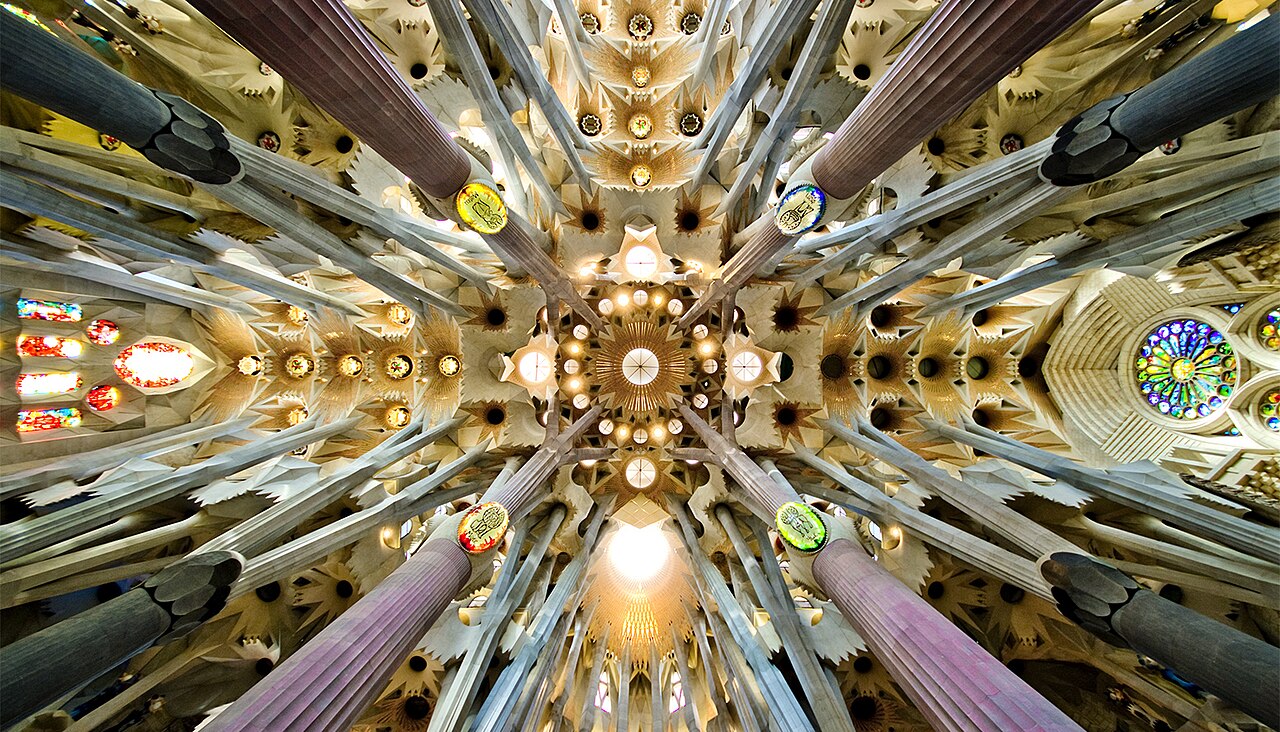
Inside the Sagrada Família, the nave does not behave like a conventional basilica hall of marching piers. Columns thicken, twist, and branch; vaults open like canopies; light arrives colored and directional. Visitors often say they feel they have entered a stone forest — and that metaphor is not poetry layered on after the fact. It is structural intention made visible. This essay slows the interior reading to hyperboloid shafts, branching capitals, and the bodily sense of walking beneath them.
First body response
Most people look up first. That reflex is correct. The canopy is the thesis. But before chasing photographs of vaults, stay with floor-level orientation: how wide the central vessel feels, how side aisles gather quieter air, how acoustic murmur softens as you move deeper from the entrance thresholds. The forest metaphor works because the space manages density and openness at once — trunks close enough to create rooms of air, high enough to release vertical escape.
Notice material temperature and color shifts between columns. Different stones and finishes mark different construction phases and load roles. The interior is a chronicle of decades written in shaft diameter and surface polish as much as in guidebook dates.
Hyperboloids and branching logic
Gaudí’s columns use ruled surfaces and branching that distribute loads the way trees do: thickening where force concentrates, dividing where the canopy needs span. A hyperboloid shaft can look as if it rotates as it rises; that optical twist is geometry doing work, not decorative flourish. Stand beside one column and let your eye travel from base to capital without interruption. Midway, the profile will teach more than any diagram.
Branching capitals refuse the classical “block and leaf” punctuation of older churches. Instead, the shaft seems to continue into vault ribs — forest trunk into bough. That continuity is why the nave feels organic even when every line is calculated.
- Pick one column and follow it from floor to vault without photographing; memory learns better than the camera here.
- Compare central vessel trunks with thinner aisle supports — hierarchy is botanical as much as structural.
- Sit for five minutes facing a colored window and watch light move across neighboring shafts.
- Return your gaze to floor transitions: where paving planes and thresholds define “rooms” inside continuous forest space.
Mid-morning cool glass and late-day warm glass rewrite the same columns. If you can, make two separate interior walks on different hours rather than one rushed circuit. The forest changes species with the light.
Vaults as canopy
Looking straight up into vault fields, the eye meets openings, stars, and geometric petals that refuse flat ceiling logic. The canopy is permeable to illumination and to symbolic sky. Hyperbolic thinking continues overhead: surfaces that look floral are often intersections of rigorous ruled forms. Nature supplied the metaphor; mathematics supplied the buildability.
Acoustics reinforce the canopy feeling. Sound softens among trunks. Choir moments, tourist murmur, footfall — each arrives as filtered noise rather than hard bounce. Listening is part of interior observation even when you are not seeking music.
Movement without urgency
Crowd flows can make the nave feel transactional if you let them. Counter that by choosing a single station — one crossing of aisle and nave, one shaft pair, one window — and remaining until urgency drains from your looking. The interior rewards stillness more than circuit-completion. When movement resumes, move laterally more than longitudinally; crossing the grain of the forest reveals new shaft alignments that frontal views hide.
Pair this essay later with stained-glass color hours. Structure without light is half the story; light without structure is spectacle without shelter. Together they are the Sagrada Família’s most persuasive argument for slow travel.
Leaving the forest
Exiting into Barcelona street glare after the colored canopy is a sensory shock. Pause on the threshold when you can. Carry one remembered hyperboloid in mind as you walk Eixample grids afterward — a private measure of how radical the interior remains against ordinary orthogonal city fabric.
We write about the nave forest as observation, never as a pitch. No urgency, no commerce. Only the insistence that tree-columns deserve longer than a passing glance.
Season after season, the same looking practice applies: arrive without commercial urgency, choose a station of attention, and stay until the basilica’s material character — stone temperature, shadow edge, and chromatic weather — becomes more vivid than any checklist of famous names. Barcelona’s light changes quarter by quarter; so does the reading. Returning readers will find that memory and live stone argue productively, refining what seemed finished on a first visit into something more patient and exact.
Sagrad Family Chronicle exists for that slower second look. Keep notes. Compare hours. Let observation outrank acquisition of views. The building rewards those who refuse to hurry past it — on the street, in the nave, or under unfinished southern skies where Glory still gathers its words in stone.
Give another quiet minute to edges, joints, and the way neighboring streets frame the temple’s mass. Small attentions accumulate into a durable memory of Barcelona’s most ambitious sacred silhouette.