The Sagrada Família is a temple you can read from kilometers away as a cluster of vertical signs. Towers — apostles, evangelists, Mary, and the rising Christ plan — translate theology into silhouette. Up close, many of those towers contain spiral ascent, ceramic finish, and changing apertures that throw patterned light. This guide balances distance reading with near looking: how the skyline hierarchy works, and what spiral geometry teaches when you are close enough to see joints and finials.
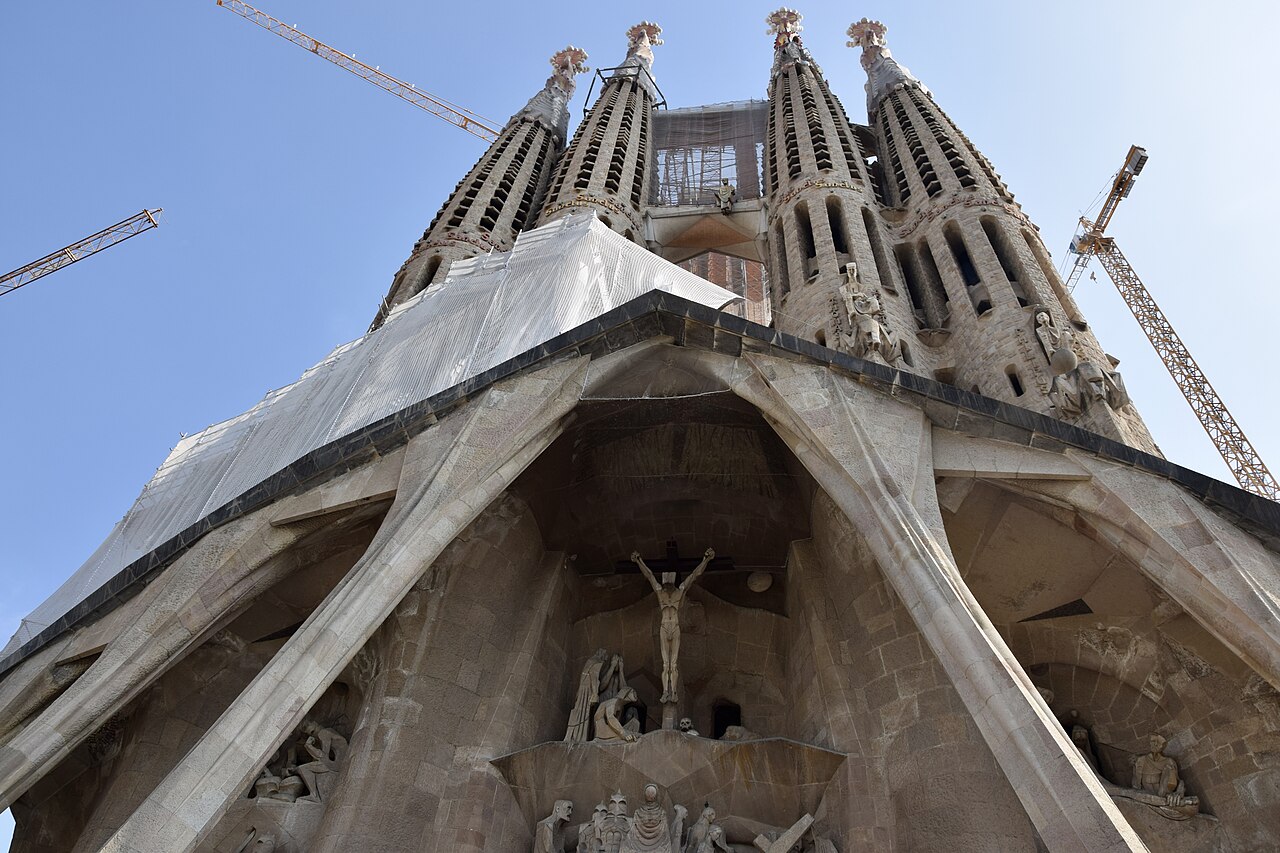
Skyline hierarchy
From distant viewpoints — Montjuïc slopes, certain coastal approaches, high Eixample crossings — the basilica reads as a measured rise of crowns. Lower apostles cluster around façades; higher towers claim mid-range attention; the central ambition presses above. Even unfinished phases of the Christ tower complex alter the skyline story year by year. Observation at distance is not static postcard hunting; it is watching a silhouette that continues to evolve.
Color matters at range. Ceramic finishes catch sun differently than raw stone, so morning pale mass and evening jewelled tip can almost belong to different buildings. Note weather: after rain, ceramic sparkles harder; in Saharan dust haze, towers soften into a single tan profile.
Spiral logic up close
Near the towers, spiral stair geometry becomes tactile. Curved walls, openwork, and slotted light create a rhythmic climb even if you remain outside looking up rather than ascending. Helical forms echo Gaudí’s preference for nature-derived structure — shells, growth, turning ascent — while remaining rigorously buildable.
Finials and lettering crowns turn theology into readable tip language for those with binoculars or good telephoto reach. Yet street-level looking without magnification still rewards: shaft proportion, taper rhythm, and the way towers emerge from façade masses without abrupt break.
- Compare morning and evening silhouettes from the same distant corner on different days.
- Walk a slow ring around the block noting which towers dominate each street approach.
- Study one spiral shaft’s light slots for five minutes — pattern repeats, then breaks at transitions.
- Relate tower height hierarchy to façade personality: Nativity softness, Passion austerity, Glory becoming.
Scaffolding eras rewrite the skyline. Photographers sometimes wait years for a “clean” silhouette. Observers can treat cranes and wrap as honest chapters: the basilica’s vertical programme is still mid-sentence.
Apostles and crowns
Apostolic towers around the façades democratize sanctity in stone — each shaft a named personage in the communal structure of the Church. Ceramics and lettering make some crowns into legible proclamations when light is right. Rather than chasing every name as a checklist, pick two towers and learn their profiles until you can recognize them from a new street angle without labels.
Evangelist towers and Marian presence refine mid-hierarchy symbolism. The pedagogical value of the programme is spatial: height equals narrative weight. Gaudí wanted the city itself to read scripture in silhouette.
Interior relationship
Tower bases and transitions connect to the nave forest. Looking from inside toward certain shafts reminds visitors that exterior silhouette and interior shelter share one structural organism. The church is not a decorated hall with towers stuck on; it is a continuous vertical organism with different skins according to light and narrative side.
When access patterns allow tower experiences on particular visits, treat elevation change as sensory storytelling — city expanding below, ceramic catching closer. When access is closed or crowded, street and distant readings remain complete essays of their own. Observation does not depend on reaching the tip.
Closing silhouette
Leave with one clear mental silhouette from a chosen street corner. Revisit it days later. If cranes have shifted or new stone has risen, congratulations — you are watching living architecture. The Sagrada Família’s towers ask for time more than for conquest of height. Observe · not book. Look up. Look again.
Season after season, the same looking practice applies: arrive without commercial urgency, choose a station of attention, and stay until the basilica’s material character — stone temperature, shadow edge, and chromatic weather — becomes more vivid than any checklist of famous names. Barcelona’s light changes quarter by quarter; so does the reading. Returning readers will find that memory and live stone argue productively, refining what seemed finished on a first visit into something more patient and exact.
Sagrad Family Chronicle exists for that slower second look. Keep notes. Compare hours. Let observation outrank acquisition of views. The building rewards those who refuse to hurry past it — on the street, in the nave, or under unfinished southern skies where Glory still gathers its words in stone.
Give another quiet minute to edges, joints, and the way neighboring streets frame the temple’s mass. Small attentions accumulate into a durable memory of Barcelona’s most ambitious sacred silhouette.
Give another quiet minute to edges, joints, and the way neighboring streets frame the temple’s mass. Small attentions accumulate into a durable memory of Barcelona’s most ambitious sacred silhouette.
Give another quiet minute to edges, joints, and the way neighboring streets frame the temple’s mass. Small attentions accumulate into a durable memory of Barcelona’s most ambitious sacred silhouette.
Give another quiet minute to edges, joints, and the way neighboring streets frame the temple’s mass. Small attentions accumulate into a durable memory of Barcelona’s most ambitious sacred silhouette.