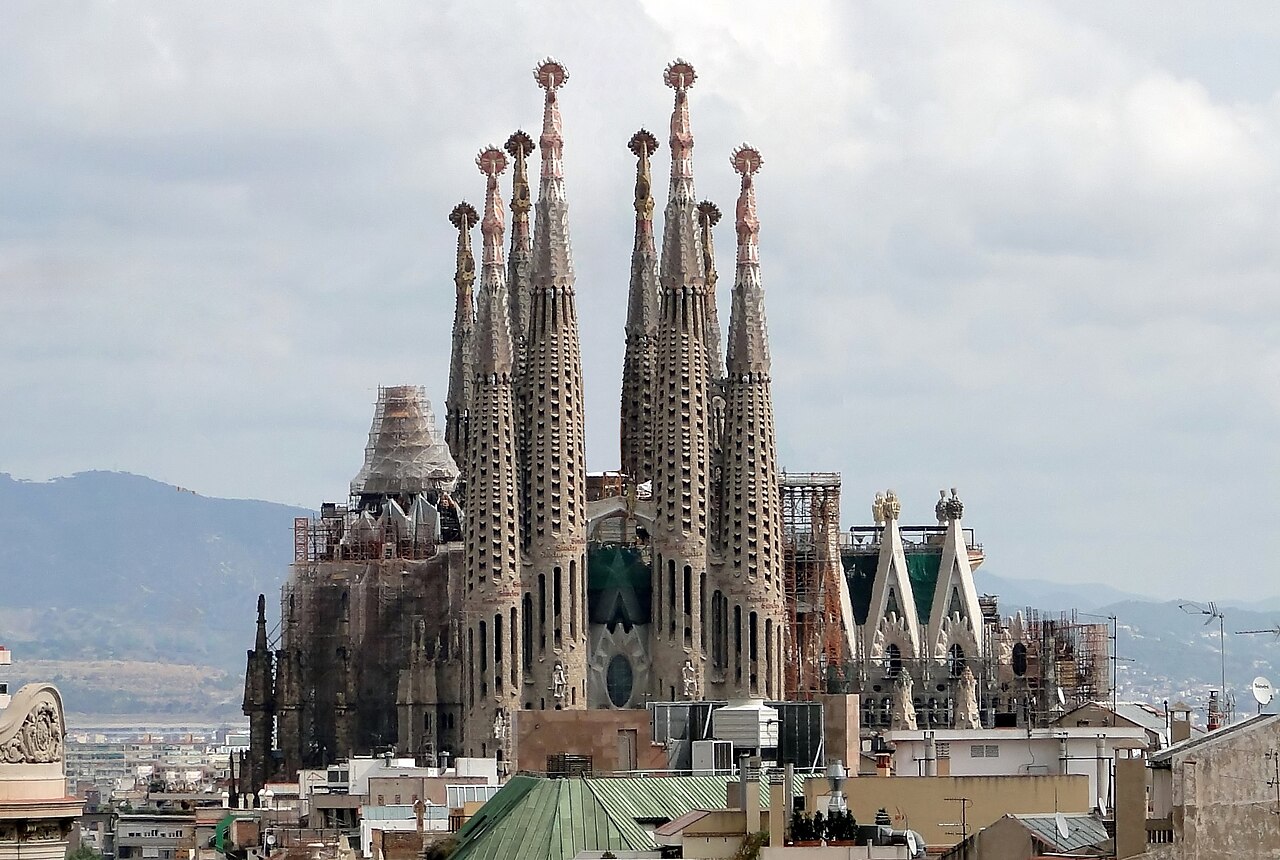
The Glory façade — the great southern elevation associated with pathways to glory, final things, and the church’s widest welcome — remains the Sagrada Família’s most unfinished public face. Visitors sometimes feel disappointment when they find worksite rather than completed tableau. This essay reframes that encounter: unfinishedness is the subject. Learning to observe a façade that is still evolving is one of the most honest ways to meet Gaudí’s temple in the twenty-first century.
Why Glory waits
Theological and constructive priority placed other elevations and the interior canopy ahead in sequence. Glory’s monumental stairs, portal systems, and sculptural programme require urban negotiation as well as craft. The delay is not neglect so much as order: birth and passion narratives and structural completion shaped decades before the south could speak fully.
Knowing that order helps observers: you are not looking at a failed façade; you are looking at a queued one mid-sentence. Time is a collaborator.
How to look at incompleteness
Identify completed modules versus provisional masses. Read scaffolding as syntax. Watch crane arcs describe future volume. Notice how finished Nativity and Passion towers already frame a southern void that yearns to join them. Incomplete stone can be as eloquent as carved narrative if you give it descriptive language — mass, void, promise, joint.
Bring sketches or verbal notes rather than only images that try to crop away workwear. Documentation that includes yellow crane against sand-colored stone will mean more in ten years than a forced “clean” crop.
- Stand south and relate Glory’s incomplete plane to finished east and west silhouettes rising left and right.
- Return across months if you live nearby — progress marks become personal chronology.
- Compare published historical models with live stone; gaps teach what remains provisional.
- Respect worksite barriers; observation from public pavement is enough for truthful reading.
Glory’s unfinishedness pairs beautifully with evening skyline walks. As light fails, incomplete masses silhouette against afterglow while finished façades retain detail. Half-built and complete speak together in dusk more gently than at noon.
Intended programme, patient reading
Historical drawings and models describe Glory as a monumental statement of faith, confession, and eschatological welcome — stairs, water associations in some visions, dense symbolic load. Without treating models as guarantees of final detail, visitors can hold intention loosely in mind while looking at current stone. Anticipation becomes part of looking, provided it does not replace attention to what exists now.
Barcelona’s street and tunnel negotiations around the south elevation add civic drama. The façade’s completion is also an urban engineering story. Observers who include that civic layer honor the temple’s entanglement with living city systems.
Glory among the other façades
Once Nativity abundance and Passion austerity are known, Glory’s future voice will arrive into a conversation already rich. Unfinished south is the pause between paragraphs. Walk the perimeter after a Glory pause and feel how east and west already answer questions the south has not yet finished asking.
Tower growth above and around Glory further complicates reading: vertical programmes advance while southern narrative sculpture awaits fuller statement. Hierarchical and narrative timelines run in parallel, not lockstep.
Leaving with living architecture
Carry away patience rather than disappointment. The Sagrada Família’s Power — for careful visitors — includes the right to remain unfinished before our eyes. That is rare among the world’s celebrated sacred buildings, many of which froze centuries ago. Here, chronicle continues.
We do not sell access or countdown offers. We ask you to observe. Return when you can. The Glory façade will have another sentence ready — or still be writing the one you first overheard on a scaffold-shadowed afternoon in Barcelona.
Season after season, the same looking practice applies: arrive without commercial urgency, choose a station of attention, and stay until the basilica’s material character — stone temperature, shadow edge, and chromatic weather — becomes more vivid than any checklist of famous names. Barcelona’s light changes quarter by quarter; so does the reading. Returning readers will find that memory and live stone argue productively, refining what seemed finished on a first visit into something more patient and exact.
Sagrad Family Chronicle exists for that slower second look. Keep notes. Compare hours. Let observation outrank acquisition of views. The building rewards those who refuse to hurry past it — on the street, in the nave, or under unfinished southern skies where Glory still gathers its words in stone.
Give another quiet minute to edges, joints, and the way neighboring streets frame the temple’s mass. Small attentions accumulate into a durable memory of Barcelona’s most ambitious sacred silhouette.
Give another quiet minute to edges, joints, and the way neighboring streets frame the temple’s mass. Small attentions accumulate into a durable memory of Barcelona’s most ambitious sacred silhouette.
Give another quiet minute to edges, joints, and the way neighboring streets frame the temple’s mass. Small attentions accumulate into a durable memory of Barcelona’s most ambitious sacred silhouette.
Give another quiet minute to edges, joints, and the way neighboring streets frame the temple’s mass. Small attentions accumulate into a durable memory of Barcelona’s most ambitious sacred silhouette.