Most essays about the Sagrada Família begin with finished iconography. This one begins with masonry: courses of stone, color shifts between campaigns, scaffolding shadows on Carrer de Mallorca, and the peculiar honesty of a sacred building that still looks like a worksite. Walking the exterior perimeter without entering remains a complete observational experience — especially for visitors who want to understand how the temple grows block by block into Barcelona’s grid.
The perimeter as a gallery
Circling the block yields four distinct urban façades and countless interstitial views down service lanes and through fence gaps. Treat the circuit as a gallery sequence rather than a photo loop. Pause at corners where two elevations negotiate; corners teach junctions that mid-block fronts hide. Listen for city noise against stone — buses, scooters, school groups — because the basilica’s exterior is ordinary Barcelona street space, not a walled cloister mute to the grid.
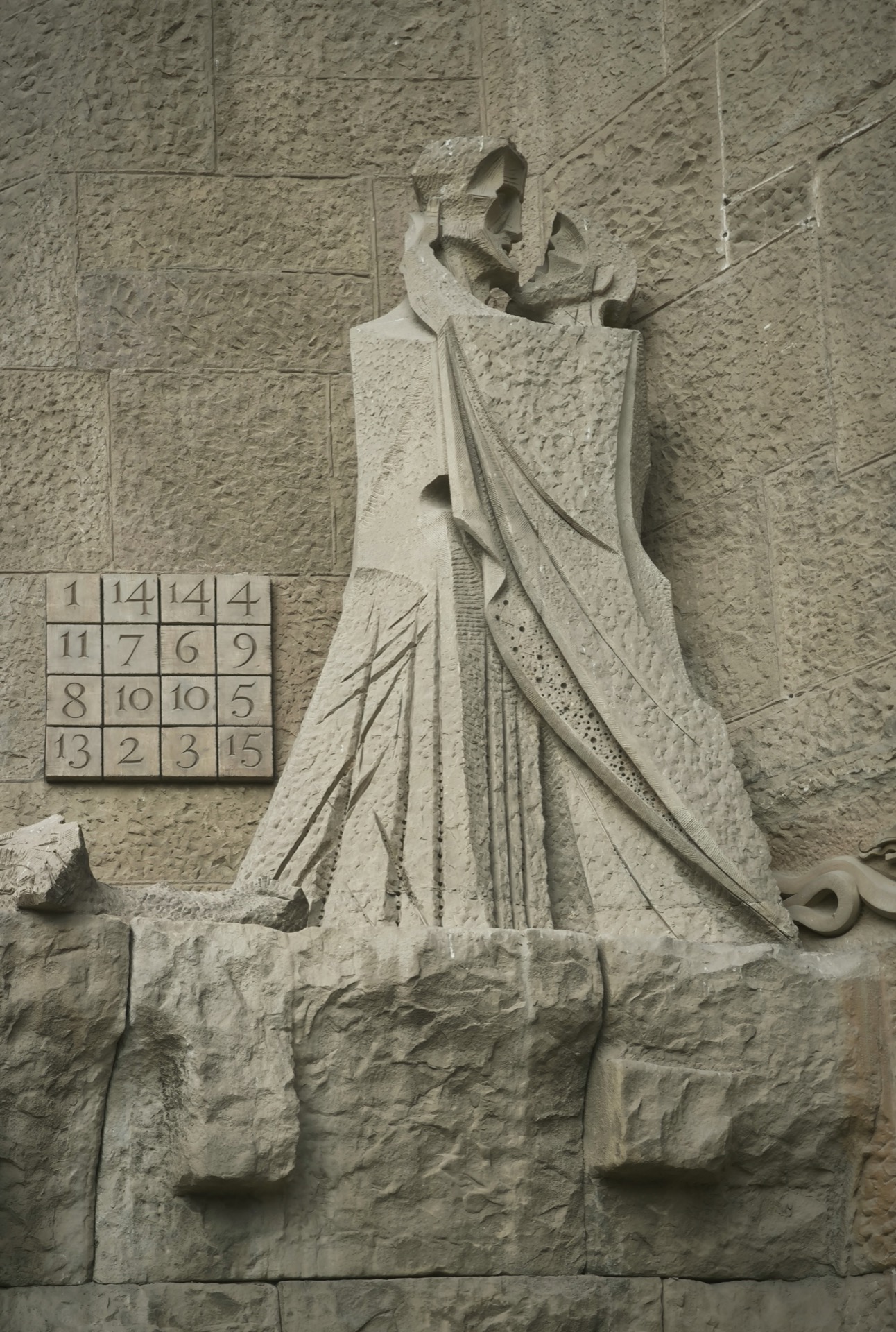
Stone color varies: cooler greys, warmer creams, cleaned versus uncleaned zones. Conservation phases leave visible seams in the chronicle. Those seams are not flaws; they are dates written in mineral.
Scaffolding as chapter
Cranes and scaffolding annoy postcard expectations and educate observers. Temporary works mark active ambition. Wrap fabrics flutter; steel lattices draw new geometries over older stone. Rather than waiting for an impossible “pure” view, photograph and remember the scaffold era as itself historic. Future visitors will envy today’s unfinished honesty.
Shadows of scaffolding on carved Nativity foliage create accidental second sculptures. Passion planes acquire linear cage overlays. Glory-side worksites may dominate for years. Each condition is time made visible.
- Complete one full block circuit without raising a camera; then reverse direction with selective shots.
- Compare joint lines and tooling marks at chest height on two different elevations.
- Note crane orientation against sky — it becomes a skyline participant beside the towers.
- Return after rain: wet stone deepens color and clarifies mason’s grooves.
Early weekday mornings often offer the quietest masonry reading. Stand across the avenue when traffic lulls and watch stone color shift as sun clears adjacent roofs — five minutes of stillness beats twenty of continuous walking.
Street approaches and urban framing
Eixample’s chamfered corners and long sightlines frame the basilica repeatedly. Approaching along different avenues yields different first impressions: tower cluster first, façade portal first, or worksite first. Your arrival street is part of your reading. Repeat visits from new approaches rewrite first chapters.
Peripheral buildings — ordinary apartments, cafés, trees — ground the temple in daily life. Framing photography that includes ordinary Barcelona fabric resists the postcard isolation that flattens context. Observation thrives on adjacent laundry lines as much as on finished spires.
Material close looking
At fence distance, study tool marks, repaired chips, and biological staining. Limestone weathering speaks slowly. Where sculpture is dense, weathering softens edges; where geometry is planar, weather accentuates arrises. Material behavior differs by elevation personality.
Do not touch precarious edges or obstruct worksite operations. Observation includes respect for continuing craft. Masons remain co-authors of the text you are reading.
Why the unfinished exterior matters
The Sagrada Família’s incomplete skin is not a bug for later correction alone; it is a living condition that teaches patience. Barcelona has hosted this growth for generations. Walking masonry with that awareness turns tourism into chronicle-keeping.
We chronicle exterior stone without selling access or urgency. Observe the blocks. Note the cranes. Let unfinishedness be the day’s most honest souvenir.
Season after season, the same looking practice applies: arrive without commercial urgency, choose a station of attention, and stay until the basilica’s material character — stone temperature, shadow edge, and chromatic weather — becomes more vivid than any checklist of famous names. Barcelona’s light changes quarter by quarter; so does the reading. Returning readers will find that memory and live stone argue productively, refining what seemed finished on a first visit into something more patient and exact.
Sagrad Family Chronicle exists for that slower second look. Keep notes. Compare hours. Let observation outrank acquisition of views. The building rewards those who refuse to hurry past it — on the street, in the nave, or under unfinished southern skies where Glory still gathers its words in stone.
Give another quiet minute to edges, joints, and the way neighboring streets frame the temple’s mass. Small attentions accumulate into a durable memory of Barcelona’s most ambitious sacred silhouette.
Give another quiet minute to edges, joints, and the way neighboring streets frame the temple’s mass. Small attentions accumulate into a durable memory of Barcelona’s most ambitious sacred silhouette.
Give another quiet minute to edges, joints, and the way neighboring streets frame the temple’s mass. Small attentions accumulate into a durable memory of Barcelona’s most ambitious sacred silhouette.
Give another quiet minute to edges, joints, and the way neighboring streets frame the temple’s mass. Small attentions accumulate into a durable memory of Barcelona’s most ambitious sacred silhouette.
Give another quiet minute to edges, joints, and the way neighboring streets frame the temple’s mass. Small attentions accumulate into a durable memory of Barcelona’s most ambitious sacred silhouette.