Standing on Carrer de Marina facing the Nativity façade is less like arriving at a church front and more like opening an illustrated manuscript that happens to be two hundred feet tall. Figures nest inside foliage, animals crowd the undercut shadows, and the three portals of Faith, Hope, and Charity organize the Joyful Mysteries into a single upward surge. This essay reads that sculpture programme slowly — portal by portal, motif by motif — so that a first long look becomes a second, deeper one.
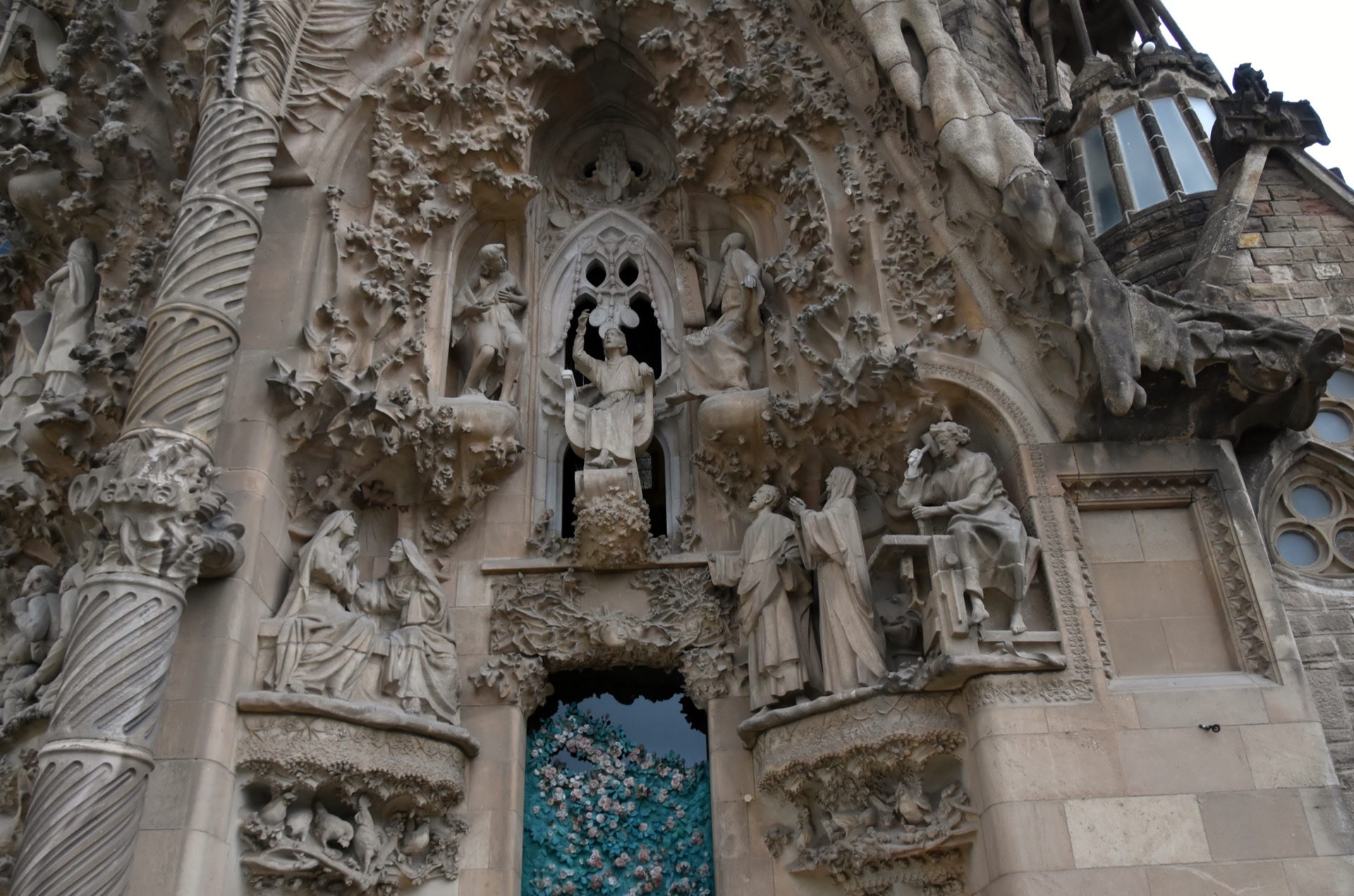
Approaching from the street
The eastern elevation still carries the softest photographic reputation of the basilica: morning light, pale stone, and an abundance of modeled detail that photographs prefer to the stark Passion side. Yet the street approach is crowded with movement — people pausing mid-block, cameras tilting upward, tour groups orbiting the perimeter. The best observational stance begins a little south or north of dead-center, where foreshortening softens and you can track how colonnettes and treelike verticals braid the façade into the towers above.
Gaudí’s intent here was theological abundance: creation overflowing into incarnation. That philosophy shows in material density before it shows in iconography. Where later façades carve with planes, the Nativity façade piles mass, undercuts, and small stories. Allow ten quiet minutes just to watch how shadows migrate across a single portal sculpture as clouds pass — the stone is animated by light even when your feet stay still.
The three portals as a map
Charity occupies the center; Hope and Faith flank it. Together they frame the birth narrative without forcing a single left-to-right reading in modern tourist time. Central Charity draws the eye first: the nativity grouping, animals at manger level, and the layered ascent toward higher registers. Hope and Faith then expand the timeline — betrothal, visitation, flight — so that the façade holds not one scene but a season of incarnation.
Look for how architecture and sculpture refuse neat separation. Capitals sprout leaves that become animals that become capitals again. Columns carry vegetal logic until figurative scenes interrupt, then resume. This continuity is the programme’s quiet thesis: the sacred story does not sit on nature like decoration; it grows out of it.
- Begin at center Charity, then scan left Hope and right Faith without forcing a single narrative order.
- Trace one vertical “vein” of foliage from street level into a tower base before chasing another figure.
- Compare morning soft light with later hard side-light — deep undercuts reveal secondary animals and birds.
- Step back to the opposite sidewalk periodically; close range collapses the portal hierarchy into texture alone.
Binoculars or a phone telephoto help for upper registers, but the street-level flora and manger animals reward the unaided eye more than any upper detail hunt. Spend your first pass below the midpoint; the façade teaches abundance at human scale first.
Flora, fauna, and theological overflow
Much of the Nativity façade’s charm for contemporary visitors is biological: lizards, birds, flora that seem drawn from Catalan landscapes rather than antique pattern books. Gaudí’s workshop studied nature as geometry and theology at once. When you notice a turtle, a chameleon, or a particular leaf cluster, you are seeing craft research turned into liturgy — the idea that creation itself praises.
That biological thickness also explains why the façade resists quick photography. A single frame will always omit half the conversation. Better to choose one pocket of sculpture — a single lintel zone, a single capital family — and stay with it until the eye invents relationships the guidebook never lists. Observational travel here means slowing past the famous Bethlehem scene into the quieter edges where craftsmanship still surprises.
Towers and the façade’s vertical ambition
Above the portals, the Nativity towers continue the east-side programme into the sky. Spiral stair geometries and finishing ceramics catch light differently than the denser sculptural base. From street level, the towers read as the façade’s exhaled breath: mass releasing into silhouette. Pairing a ground reading with a later interior climb or distant skyline view (on other days) clarifies how eastern abundance feeds the basilica’s crown.
Remember that stone cleaning and restoration alter color temperature over years. What looks warm cream in one season may read cooler after conservation campaigns. Color is not fixed iconography; light and conservation are part of the living façade text.
Closing the first reading
A complete first reading of the Nativity sculpture programme is not a checklist of named figures — though knowing the portals helps — but a felt sense of denseness, generosity, and upward pull. Come back in different weather. Rain darkens carved recesses and clarifies edges; harsh noon flattens them; late afternoon draws long shadows that act like additional chisels.
Sagrad Family Chronicle frames this façade as observation, not transaction. Read the stone. Carry the image. When you later stand in the nave forest or face the Passion’s angular austerity, the Nativity’s abundance will remain the emotional baseline against which every other elevation of the Sagrada Família is measured.
Season after season, the same looking practice applies: arrive without commercial urgency, choose a station of attention, and stay until the basilica’s material character — stone temperature, shadow edge, and chromatic weather — becomes more vivid than any checklist of famous names. Barcelona’s light changes quarter by quarter; so does the reading. Returning readers will find that memory and live stone argue productively, refining what seemed finished on a first visit into something more patient and exact.
Sagrad Family Chronicle exists for that slower second look. Keep notes. Compare hours. Let observation outrank acquisition of views. The building rewards those who refuse to hurry past it — on the street, in the nave, or under unfinished southern skies where Glory still gathers its words in stone.